

About the Project
News
Week two of the I-5 shutdown is behind us
Traffic Report: Travel times increased in week two
Our traffic teams continue to monitor traffic patterns around the Rose Quarter and throughout the region as the closure goes on. In week two we’re continuing to see a rise in traffic. It’s just as important as it was last week for travelers to continue planning ahead, building in more time to reach destinations, and to expect delays—even if you haven’t encountered them yet.
In general, more people are back on the roads. Overall, average travel times on Monday increased by about 5% over last week and average travel times on Tuesday increased by about 10% over last week.
Alternate modes of travel—like bike, bus, streetcar, or train—are another option to consider as we navigate the southbound closure. TriMet continues to provide reliable travel options during construction, with MAX trains departing every 15 minutes throughout most of the day. TriMet experienced an uptick in ridership during the first week, particularly on the MAX Yellow Line, operating between Expo Center and Downtown Portland. From Sept. 13-19, riders took more than 18,000 additional trips on the Yellow Line.
Even with the increased ridership, there’s abundant room for more riders. Trains are not completely full, and there are plenty of parking spaces still available at TriMet’s various Park & Ride facilities if you’re thinking of shifting to transit during the closure. It’s a great time to save some gas money, sit back, and let a train or bus chauffeur you to your destination. Those who would like to plan their transit trip in advance are encouraged to visit trimet.org.
You can find more information about how to get around on the Closure Travel Resources page and the City of Portland’s Shift Your Trip page. Check TripCheck before you head out for the latest travel conditions.
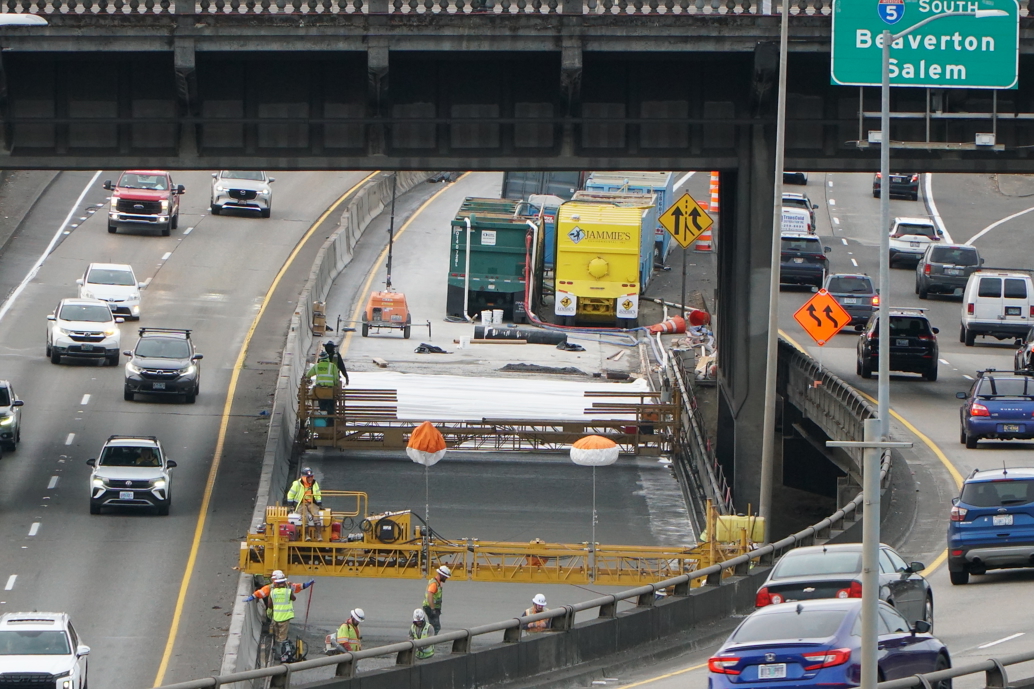
Crews beginning pavement operations work on the I-5 mainline.
Upcoming and ongoing closures:
|
Location |
Closure |
Detours |
|
NE Oregon Street (sidewalk) |
Sept. 21 – Oct. 11 for seismic resiliency work. |
Pedestrian traffic to use the south side of the street. |
|
I-5 northbound (right lane only) between Greeley exit and I-405 |
Sept. 28 – Oct. 2, overnight (10 p.m. – 5 a.m.) for stormwater pipe work. |
N/A |
|
I-5 northbound (left lane) between Burnside Bridge and Oregon Convention Center |
Sept. 28, overnight (10 p.m. – 5 a.m.). Single-lane closure to allow extra space for concrete pour. |
N/A |
Visit our Construction Travel Impacts page to view maps and additional details. Sign up for email and/or text alerts to stay up to date with the latest news on traffic impacts and active closures.
Construction progress: New concrete placement begins
We’re at the end of the second week of the closure, and construction remains on schedule, with major milestones reached. Crews have completed more than 11,000 square yards of micromilling and hydrodemolition to remove the deteriorated top layer of concrete. All 28 bridge spans have also been inspected for areas of weakened concrete and crews have removed and repaired these deteriorated areas.
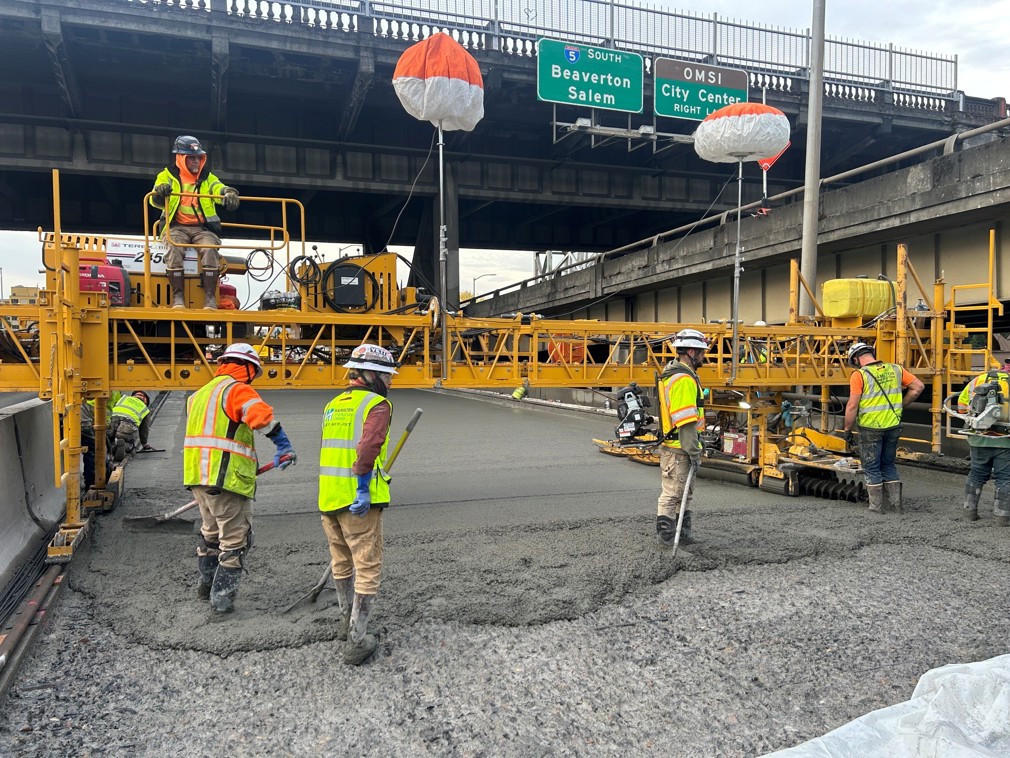
Construction crews pour concrete on a section of I-5 southbound.
Following the successful concrete pour on the I-84 off-ramp, crews started the first major I-5 mainline pour early Thursday morning; this section was completed by mid-day Thursday. Friday’s scheduled pouring was delayed due to heavy rain in the forecast, though concrete pouring will resume Saturday morning and continue through early next week.
Since this section of I-5 is a bridge, extensive preparation is required to ensure that each pour goes well. One element of preparation is staging the deck-paving machine, which includes setting up equipment and work areas, and carefully covering bridge joints to prevent concrete from seeping into them.
Your questions, answered
Here are some of the top questions we’ve received in week two of the closure:
Q: Why don't you have a longer dedicated lane for traffic exiting I-5 southbound at the Broadway exit?
A: This is a safety issue. Allowing drivers to enter the exit ramp earlier could create a conflict at the split, where some drivers may try to move back into the mainline at the last moment. This can cause safety risks when traffic on the mainline is moving slowly, while drivers entering the exit ramp can quickly accelerate to 50 miles per hour. The large difference in speeds can increase the risk of conflicts and crashes.
At the start of the closure, we observed several instances of this behavior, including some close calls. In response, we adjusted the available length of the exit ramp to reduce the opportunity for last minute lane changes and improve safety.
Q: Have you coordinated with other roadway construction projects in the area?
A: Multiple agencies have active projects to maintain the aging system, including the Oregon Department of Transportation, Portland Bureau of Transportation, TriMet, and C-TRAN. We work together to coordinate traffic impacts as much as possible.
For example, project managers for projects throughout the region meet monthly to discuss upcoming traffic impacts and identify ways to address potential issues. During the current I-5 southbound closure, agencies are meeting twice a week to discuss traffic conditions, identify issues, and coordinate responses. This ongoing coordination helps minimize major backups while allowing needed improvements and maintenance to continue.
Q: What’s the best route for me to get from point A to point B?
A: Congestion will be hard to predict day to day during the closure, so navigation apps like Google, Apple, and Waze will be your best tools for figuring out the best and quickest routes for daily travel during the closure. We also encourage you to shift to alternate modes of transportation during the closure whenever possible. This can include carpooling, using public transit, or taking that bike out of storage. Finally, adjusting your travel time may help you avoid delays. We have created a travel resources page to help people plan their trips.
Translation/Interpretation Accommodations
For ADA Title II or Civil Rights Title VI accommodations, translation/interpretation services or for additional information call 503-731-4128, TTY (800) 735-2900 or use the statewide Oregon Relay Service: 7-1-1.
Si desea obtener información sobre este proyecto traducida al español, sírvase llamar al 503-731-4128.
Если вы хотите, чтобы информация об этом проекте была переведена на русский язык, пожалуйста, звоните по телефону 503-731-4128.
如果您想瞭解這個項目翻譯成 繁體中文 的相關資訊,請致電 503-731-4128.
如果您想了解这个项目翻译成 简体中文 的相关信息,请致电 503-731-4128.
이 프로젝트에 관한 한국어로 된 자료 신청방법 전화: 503-731-4128.
Nếu quý vị muốn thông tin về dự án này được dịch sang tiếng Việt, xin gọi 503-731-4128.

For 24/7 road conditions and traffic alerts visit tripcheck.com or call 5-1-1.
Visit the Portland Area Construction Information website for more information about projects in construction.